Friday, September 7

Punjab holocaust of 1947

Ishtiaq Ahmed revisits partition to note that the gangs from Hindu, Sikh and Muslim communities excelled each other in inflicting cruelty on hapless men, women and children
Intelligence about private armies and sale and movement of arms and ammunition had been collected by the Punjab administration since a long time, and the fact that a very large population in Punjab had served in the army should have left no doubt that a bloodbath would occur if proper arrangements were not made to prevent it. The Sikhs could always use their kirpans as daggers. They were also better organised for the final showdown. Governor Jenkins requested at least four divisions of troops under British command to supervise the partition, but the British government replied curtly that no such divisions existed. Mountbatten remained supremely confident that Jinnah, Nehru, Patel, Tara Singh, Giani Kartar Singh and others would exercise their influence in seeing to it that the partition of Punjab could be carried out peacefully without causing any displacement of people!My extensive interviews with Muslim survivors from East Punjab show that almost nobody in the rural areas had any idea that Punjab will be partitioned; much less that they will have to abandon hearth and home. Hindus and Sikhs in the villages and small towns of western Punjab were equally unaware of what lay in store for them, although half a million had moved eastwards beginning from March 1947. Conspiracy theories have surrounded the Radcliffe Award of August 17, but a serious analysis would reveal that it largely followed the "contiguous population" principle and "other factors" were only recognised partially. Thus despite Sikh and Hindu arguments about owning 75 per cent or more property in Lahore and other districts of Lahore division they were given to Pakistan including Nankana Sahib, the birthplace of Guru Nanak; so were the canal colonies of Lyallpur and Montgomery where the Sikhs owned nearly 75 per cent of rich agricultural land. In any event, the Sikh holy city of Amritsar remained in India because Amritsar district had a non-Muslim majority. But three tehsils of the Gurdaspur district on the eastern bank of the Ravi -- Gurdaspur, Batala and Pathankot (non-Muslim majority) -- were given to India, although the district as a whole had a very narrow Muslim majority of 51.1 per cent. Thus the non-Muslim majority Ferozepur district in the southwest and Gurdaspur district (minus Shakargarh which was on the western bank of the Ravi and given to Pakistan) in the northeast and the Wagah-Attari region in the middle were connected to form an international border more or less equidistant between Lahore and Amritsar. From Lahore the border followed the Ravi upwards into Kashmir. For serious scholars of the Radcliffe Award it would be interesting to note that it corresponded exactly to the Breakdown Plan which Viceroy Wavell had sent as a top secret document to London on February 7, 1946. Wavell believed that the British should pull out quickly in case of an uprising. He had proposed a border in a partitioned Punjab, which was identical to the Radcliffe Award.From August 18 onwards hell literally broke loose, especially in East Punjab where troops from the Sikh states such as Patiala, Nabha and Faridkot were involved in the attacks. The successor governments of East and West Punjab proved thoroughly incompetent in protecting the lives of the minorities. There is abundant evidence that the administrations turned partisan on both sides. Suddenly the greatest involuntary migration in history began to take place. The Punjab Boundary Force was disbanded on September 1 as it proved to be completely ineffective and in some cases partisan. The Indian and Pakistani military then agreed to form mixed units to supervise transfer of populations. This formula worked much better and hundreds of thousands of lives could be saved, but even their best efforts proved to be grossly inadequate.From East Punjab some six million Muslims tried to cross the border into Pakistan while some four million Hindus and Sikhs moved in the opposite direction from West Punjab. According to Sir Penderel Moon 60,000 Hindus and Sikhs were killed in West Punjab and twice as many: 120,000 Muslims in East Punjab. This estimate is too low. Justice G D Kholsa claimed that at least 500,000 died, of which 200,000 to 250,000 were Hindus and Sikhs. He admitted that more Muslims were killed in East Punjab than Hindus and Sikhs in West Punjab. Lt-General (r) Aftab Ahmad Khan who served in the Punjab Boundary Force and then in the Pakistani force that along with Indian units escorted refugee conveys across the border, claimed in a letter to me that at least 500,000 Muslims lost their lives. I have done interviews on both sides of Punjab. There is no doubt that many more Muslims lost their lives. Between 700,000 and 800,000 Hindus, Muslims and Sikhs perished altogether. That year the monsoons were also in a bloody mood. A large number of deaths was the result of cholera, dysentery, malaria and typhoid which plagued the refugee camps and the caravans on the move. Good people from all communities helped their neighbours and friends and even complete strangers. The Khaksars did a great job in protecting Hindus and Sikhs in Rawalpindi while in Amritsar the communists will never be forgotten for saving thousands of lives. The Sikh hordes did not touch Muslims who crossed into Malerkotla State, but those just a few feet away from its borders were cut down without any mercy. Thanks to Guru Gobind Singh's instructions, the Muslims of Malerkotla were not to be harmed come what may in the future because the Nawab had not complied with the demands of the Mughals to arrest the Guru's minor sons who were passing through his State. Malerkotla is the only Muslim-majority town in East Punjab and elects one member of the East Punjab Assembly. The killing units on both sides were formed by nexuses of local political bosses, police, corrupt magistrates, badmashes (criminals), fanatical religious figures and drug addicts from all the communities. The gangs excelled each other in inflicting cruelty on hapless men, women and children. Revenge, "communal honour", loot and lust were the main factors that impelled them to commit crimes against humanity. There was nothing remotely noble about their conduct. In this regard the shameful role of communal newspaper needs to be particularly condemned. They played a most vicious role in creating the mindset that demonised and dehumanised rival communities. As far as the main leadership is concerned, we should note that a Gandhi-Jinnah peace appeal was issued as early as mid April 1947, but it did little to change the situation on the ground. Jawaharlal Nehru intervened personally to save the lives of thousands of Muslims in Batala and Jalandhar while the goondas of Sardar Patel funded bomb factories in Amritsar and elsewhere. Prime Minister Nehru and Prime Minister Liaqat Ali Khan together toured the two Punjabs in the last days of August trying to calm down the situation, but things had gone out of control. Although Delhi was not administratively a part of Punjab its Muslims had to bear the fallout of the Punjab bloodbath. The late Dr Ishtiaq Hussain Qureshi has written what happened to thousands of desperate Muslims who pleaded to Gandhiji to save them. He promised to do his best. Dr Qureshi notes that most of them survived and concludes that Gandhiji kept his word.
The writer is professor of political science at the University of Stockholm, Sweden. Email: Ishtiaq.Ahmed@statsvet.su.se

Friday, August 31

Punjab needs new plough to regain leadership

Punjab needs to make changes to regain its leadership role in agriculture, but is it ready to do so, ask Ashok Gulati, Ralph W Cummings Jr & Kavery Ganguly in The Economic Times, as they offer some suggestions to policymakers
Punjab’s agricultural success, dominated by wheat and rice, seems to have slowed down since the early 1990s. The sources of growth — land and yields — are reaching capacity. Wheat and rice cover over three-quarters of cropped area. Cities are expanding. Further land for agriculture is exhausted. Rice yield has almost stagnated, increasing only 0.02% annually during the 1990s, but has had some recovery since then, and wheat yield has slowed down significantly, declining from 3% annual gain in the 1980s to 2% in the 1990s, and has been negative in the early 2000s. Future income gains are likely to be confined to increases in prices. But consumption patterns are shifting away from wheat and rice. And the future is even less promising because Punjab is experiencing increasing stress on natural resources, which will further impact yields and constrain acreage. The potential answer for income augmentation is diversification — dairy, poultry, eggs, fruits and vegetables, and traditional commodities such as cotton, sugarcane, maize for feed, fodder, durum wheat, organic and basmati rice, selected pulses and their processing. Demand is robust, and economics favourable. However, farmers with relatively small quantities and limited markets face major problems, including high price and production risks, high transactions costs and high perishability in some of these. New institutional arrangements, including contract farming, co-operatives, producers’ companies and retailing are responding to those challenges. If these prosper, three things will follow: The India food chain will be radically changed, operating on a nationwide distribution infrastructure and transforming the way India shops and consumes. The huge amount of retail investment by major businesses will practically guarantee success if supplies can be obtained. There will be a rush to tie up producers to provide the supplies. However, as of now, trust between farmers and corporate companies is weak. The key challenge is who — agribusiness or farmers or both — will take the first step? But two major impediments stand in the way. First, the government has an open-ended public foodgrain management system, which is saddled with large subsidies. This, however, provides an assured market for wheat and rice and thus takes away most of the incentives for investing in infrastructure that would be more suitable to support high-value agriculture. This needs to change.
The government needs to decouple support price from procurement price, allow private sector to procure, trade and stock without any restrictions, including operations in futures markets. Second, subsidies on fertiliser, irrigation and power which arguably initially motivated farmers, especially small farmers, to adopt new technologies of wheat and rice and improve their yields have now turned perverse. These subsidies are now leading to highly unbalanced use of fertilisers, lowering water table and creating a crisis in the sustainable use of natural resources. This must change by undertaking a major exercise towards their rationalisation. A high degree of political commitment and long-term vision of Punjab is needed. Rationalisation of power and irrigation subsidies must accompany improvement in their quality of services, else it would be a non-starter. Similarly, fertiliser subsidy can be given directly to farmers through fertiliser coupons rather than through fertiliser industry. With money saved from reforming public foodgrain management and input subsidies, the government can do certain key things: Facilitate strengthening of private participation and marketing through freeing up of land lease markets, reforming the Agricultural Produce Marketing Committees (APMC) Act and abolishing the Essential Commodities Act. Improve environment in which high-value commodities can operate by investing in (roads and dedicated market yards) and providing incentives to the private sector to modernise infrastructure and institutions (risk mitigation strategies, insurance markets, storage infrastructure) to handle the special marketing and processing needs of high-value commodities (like cold storage, SPS, etc). Strengthen agricultural research on high-value commodities Looking twenty years to the future, we envision a very different Punjab agriculture than we see today — Punjab agriculture devoted 60% to high-value commodities and a broader mix of traditional commodities and 40% to wheat and rice; strong agricultural research at the Punjab Agricultural University (PAU) on HVCs; modern processing plants located throughout the state; bakery hubs around major mandis; processing and retailing institutions such as business-oriented co-operatives, contract farming and supermarkets linked to farmers; and fast-moving infrastructure, including cold storage chains, improved highways/rail lines and an international airport. Punjab is clearly at the crossroads. All incentives are stacked in favour of wheat and rice. The situation is not yet at a crisis. Incomes are stagnating in the near-term. However, in the longer term, changing demand and deteriorating environment will lead to progressively decreasing incomes. Can Punjab make the needed changes to regain its leadership role in agriculture?
(Gulati is director in Asia; Cummings is a freelance consultant; and Ganguly is a research analyst at International Food Policy Research Institute)

Wednesday, August 29

Punjab’s ‘empty coffers’

Instead of seriously applying corrective measures, the political leadership is taking an easy route of indulging in blame games whereas both the regimes failed to apply fiscal discipline leaving no money for development and embroiling state in virtual debt trap, asserts Dr. S.S. Johl in The Tribune
It has become a compulsive reactive norm for all political parties in India that while in opposition they would oppose every good or bad action of the government and when in power, would shift the blame of their non-performance on the previous government.
This is particularly so at the level of provincial governments. Taking Punjab as an illustration, the state is in virtual debt trap today. Government machinery, comprising politicians and employees has become self serving. The revenue expenditure has been constantly exceeding the revenue receipts for the last two decades and has now reached disquietening levels.
The government borrows heavily to fill the gap between revenue receipts and revenue expenditure in order to pay salaries, pensions, interest on debt and meet other committed expenses. There is virtually no money left for development.
Day by day the state finances are taking deeper and deeper plunge. Instead of going serious to apply corrective measures, the political leadership is taking an easy route of indulging in blame games.
“The previous government emptied the coffers” was the charge repeatedly made by the previous Parkash Singh Badal government. The subsequent Congress government raised the pitch of this statement and now the Akali-BJP government has picked up the threads again and is repeatedly blaming the previous government for the financial mess created during its regime leading to “empty coffers”.
Let us look a bit analytically at the mess created by these two regimes. The state started witnessing an annual revenue deficit from the financial year 1987-88 with revenue expenditure exceeding the revenue receipts by Rs. 229.02 crore. The revenue deficit never looked back thereafter.
When the previous Akali-BJP government took over in 1997, the revenue deficit was Rs 1,357.06 crore (in 1996-97). In their first budget of 1997-98 they raised it to Rs. 1,483.90 crore. By 2001-02, the revenue deficit increased to Rs. 3,781.19 crore.
In the five-year regime, the total revenue deficit amounted to Rs. 12,958 crore. This works out to an average annual excess expenditure of Rs. 2,591.60 crore on revenue account over the revenue receipts.
The Congress government started with the budgeting of revenue deficit at Rs. 3,753 crore, marginally lower by Rs. 27.25 crore from the previous year deficit of the Akali-BJP regime. This government brought the revenue deficit down to 2,190.60 crore in the budget of 2006-07. Yet, the Congress government incurred a revenue deficit of Rs. 15,138.30 crore in five years, clocking an average revenue deficit of Rs. 3,027 crore per annum.
With this mounting annual revenue deficit, the total debt stock of the state increased from Rs. 15,250 crore in 1996-97 to Rs. 32,496 crore in 2001-02 during the previous Akali-BJP regime.
This piling up of the debt stock occurred despite the fact that the Central government and the Finance Commission waived the special term loan amounting to Rs. 2,433.74 crore in three years from 1997-98 to 1999-2000.
Thus the Akali-BJP government increased the debt stock of the state by Rs. 17,246 crore in spite of this waiver. By the time the Congress government demitted the office this year, the debt stock of the state had risen to Rs. 47,801 crore.
This government added Rs. 15,305 crore to the debt stock of the state in the five years of their governance. Now the Akali-BJP government, while whipping the previous regime for “emptying the coffers”, itself has budgeted an addition of Rs. 4,963 crore to the debt stock of the state raising it to a level of Rs. 52,764 crore.
These borrowings by the successive governments have landed the state into a situation of virtual debt trap. The annual burden of interest on debt stock of the state which was Rs 161.19 crore in 1987-88, when the state started showing revenue deficit, rose to Rs 1,634.44 crore in 1996-97.
Both the regimes failed to apply fiscal discipline and are equally responsible for the financial stress on the public exchequer. This is a typical case of the pot calling the kettle black and it is being done with impunity.
There is nothing like trunks and coffers that get filled up by one regime and emptied by the other. It is not that political leaders do not understand it, but they are unable to restrain themselves from this blame-game and thereby befooling the masses endlessly.
If the parties in power have the interest of the state in their priorities, they must resort to fiscal discipline. For instance, on expenditure side, administrative structure must be rationalised, downsized and made more efficient. Corporations and public enterprises running into constant losses that are not capable of making any profit, must be wound up, the committed expenditure must be rationalised and reduced. Subsidies must be targeted to the really deserving beneficiaries and every expenditure must undergo an impact analysis.
Above all, the political burden on the exchequer must be reduced, which is a heavy cost on account of accommodating party politicians in positions like parliamentary secretaries, chairmen of corporations and boards etc and police security be reduced from a status-symbol to the bare necessity.
On the revenue side, the tax structure must be rationalised, the revenue leakage and tax evasion must be checked. Accountability of the tax collectors be ensured and tax payers be treated with respect. The introduction of a credible social security system for the taxpayers can go a long way in boosting the state revenue receipts.
These are quite feasible options, but require a change in the mindset from myopic politics to statesmanship that will entail long-range vision and political will to take hard decisions, that are utterly lacking in our political class of today.

Tuesday, August 28

All in a Day's Work


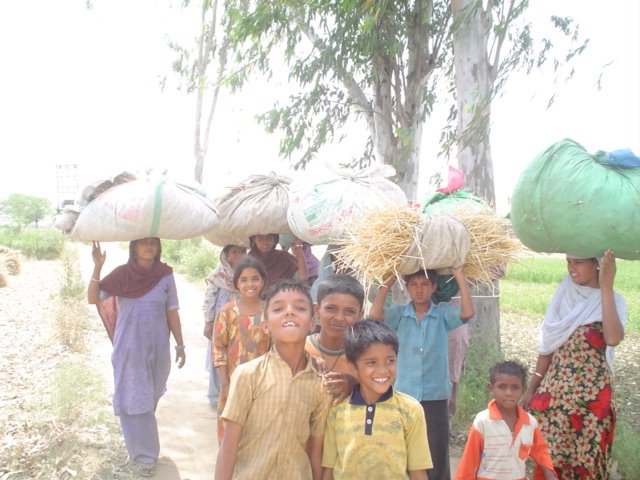
Besides other household chores women folk have to arrange for fuel too. Whole family chips in, including children. pic: jaypee

Saturday, August 18

Heroes & Villains

The Weekly Outlook in its special issue India at 60 assembled a list of 60 people to represent sixty years of the Republic as its heroes. It duly mentions hockey great Balbir Singh, writer Khushwant Singh, Prime Minister Manmohan Singh and Raj Kapoor among these. But for anyone looking for Punjab connection its not the inclusion of these four that makes the list interesting, it’s the list of villains. It includes Bhinderawala along with the assassins of Indira Gandhi as well as HKL Bhagat, Sajjan Kumar, Jagdish Tytler.
HEROES
Manmohan Singh
The Post-Gandhian
He is more than just the architect of India’s economic reforms. In an era of corruption, his personal life is above reproach. In a time of intellectual bankruptcy, he tries hard to make ideas fashionable. In a period of bitterly polarised positions, he stands for consensus.


Balbir Singh
Magic Stick
He symbolises the Golden Age of Indian hockey. As centre-forward, he was part of the team that won Olympic Golds in 1948, 1952 and 1956, and Asian Games Silvers in 1958 and 1962. He was also an inspired coach, who took India to World Cup victory in ’75.


Raj Kapoor
Showman
Independent India’s first film icon, this consummate showman’s appeal captured audiences from China and Moscow to Cairo and Timbuktu—his cultural diplomacy for India was unparalleled. In the ’50s and ’60s, his roles projected a sense of idealism, hope and confidence, and the dream of bridging social, economic and political inequalities, something that struck a special chord in the newly independent nation.

Khushwant Singh
Editor-Writer
A pioneering historian of the Sikhs, the author of a fine novel about Partition, editor, memoirist, columnist and political naif, he is a man of many parts, but he’s here as the writer who invented himself: the hard-drinking, wise-cracking, godless sardar taking on hypocrisy.


VILLAINS

Jarnail Singh Bhindranwale
He's a reminder of how quests for religious purity can turn rabid. He emerged in the 1970s as a preacher seeking to reform the Sikhs who, swayed by prosperity and modernity, had taken to drugs and clipping their beards. This 'holy quest' inspired him to target the Nirankari sect, whom he considered untrue Sikhs, earning himself a huge following overnight. Emboldened, Bhindranwale hijacked Punjab's autonomy movement, subsequently piloting it on a flight to Khalistan. He ordered killings of Hindus as well as of Sikhs who opposed him. The nightmare lingered even after he died in Operation Bluestar in June 1984.

Beant Singh and Satwant Singh
When Indira Gandhi stepped out of her 1, Safdarjung Road residence on October 31, 1984, her scheduled appointment with British actor-director Peter Ustinov turned into a tryst with death. As she approached the wicket gate connecting her home to her 1, Akbar Road office, Beant Singh and Satwant Singh opened fire.Ustinov, years later, said, "What struck me as almost incredible was the activity of squirrels and vultures in the garden. They went on through the whole unpleasant business without interruption." But India was never the same. Indira's assassination prompted vast changes in the security architecture: its structure became mammoth, the vetting of security guards on VIP duty an elaborate, complex—even communal—exercise.

HKL Bhagat, Sajjan Kumar, Jagdish Tytler
They are the Congress party triad accused of fomenting the grisly 1984 Delhi riots, during which helpless Sikhs were set upon by bloodthirsty mobs aiming to avenge the assassination of Indira Gandhi. One inquiry commission after another—the last being the Nanavati Commission—has found evidence of their complicity in what was, like the Gujarat riots, a veritable pogrom. But all the 'credible evidence' couldn't nail the trinity in any court, revealing the Indian state's propensity to align with communalism. Writer Khushwant Singh said about those days, "I felt like a refugee in my country. In fact, I felt like a Jew in Nazi Germany."