Tuesday, November 21

Punjab bureaucrats on overseas flying binge

At a time when the Punjab Government was struggling to fill its empty coffers, some bureaucrats continued their extravagant spree of flying around the globe at the cost of the taxpayers' money, reports Satinder Bains in The Pioneer.

Two senior IAS officers PK Verma, former Financial Commissioner (Development), and Himmat Singh, Managing Director of Punjab Agro Industries Corporation (PAIC) ended up spending over Rs 50 lakh on about 20 foreign jaunts claiming about 20 per cent of the total amount of Rs 2.83 crore spent by about 50 bureaucrats in the past about four years.
Himmat Singh alone cost the State exchequer a whopping Rs 43,62,178 on 14 visits to countries like France, the United States, Canada, the United Kingdom, Japan, Singapore, Holland, Germany, Italy and South Africa. He was accompanied by Verma on five visits. All their expenses were borne by the PAIC. Himmat Singh and Verma had visited France in May 2003 to settle certain legal dispute with M/s Red Bridge holding company that cost the State exchequer about Rs 8 lakh. The two officers travelled around the world for marketing agro products like fresh juices and vegetables, processed food, peanuts/ground nuts for confectionery etc. They also claimed to have surveyed the foreign markets to bring latest technology for agro industry.
Arun Goel, who remained Managing Director of Punjab Small Scale Industry and Export Corporation (PSIEC), made seven trips for export promotion to countries like Australia, Brazil, Chilly, Paraguay, Columbia, Venezuela, Russia, Ukraine, Poland, Croatia, Kenya and Malaysia. The State spent Rs 23,14,205 on his visits abroad, out which Rs 17,97,000 were paid by PSIEC and the remaining paid by the Sports department when he remained Secretary Sports for a short stint.
He watched ICC World Cricket Cup in 2003 in South Africa at Government expense that amounted to Rs 2,22,691.
He also watched Busan (UK) Games in November 2002 that cost Rs 2,94,514. Goel spent another Rs 1,85,000 when he attended the Handloom Weaving Training Project in Kenya even while the handloom industry in Punjab has almost vanished.
Nirmaljit Singh Kalsi, another senior IAS officer who has been holding charge of the department of Information Technology for a long time and is also Managing Director of Punjab Infotech, cost the State exchequer Rs 20,65,793 on nine foreign visits to the USA, Canada, China, Dubai, Singapore, Australia, the UK, Atlanta and Germany.
Kalsi's entire expense was charged to Infotech and the reasons he cited for visits were again to market Punjab for foreign investment in IT industry. He also accompanied the Chief Minister on a few visits during the 'Made in Punjab' campaign held in the USA and Canada.
DS Jaspal, the high profile IAS officer who handled the departments of Information and Public Relations besides CEO Ananadpur Sahib Foundation, cost the State Rs 15,06,635 on six visits to the USA, Canada, besides Geneva, the UK and Pakistan.
Of the total State expense incurred on Jaspal, Ananadpur Sahib Foundation paid Rs 11,49,721 since his visits were aimed at fund raising from NRIs for the Khalsa Heritage Complex at Ananadpur Sahib. Geetika Kalha, DS Kalha and Romila Dubey during short stint at the Foundation also made one visit each for fund raising for the Khalsa heritage.
KR Lakhanpal, Chief Secretary of Punjab, made only four visits abroad, of which three were as Chief Secretary, for which the State spent Rs 14,57,927 when he went to Thailand, Singapore, Bangkok, Australia, Dubai, Kuala Lumpur, the UK and the USA for short durations.
Sarvesh Kaushal, Principal Secretary of School Education, when he was Secretary Sports 2004 went to see Olympic Games at Athens (Greece) at Government expense. His two trips cost Rs 6,05,621 to the State Government.
DS Bains, Principal Secretary of Animal Husbandry visited Dubai, Egypt, Pakistan and Canada to procure high quality semen. JS Maini, resident commissioner, Delhi, has made two trips to the US and Canada and spent about Rs.8 lakh.
Some of the other Boards and Corporations paid for the foreign tours of IAS officers. The corporations included Punjab Water Supply and Sewerage Board, Punjab Infrastructure Development Board, Punjab School Education Board, PUDA, Punjab Mandi Board and Punjab State Electricity Board.
The other prominent officers who enjoyed the foreign jaunts included Vishwajit Khanna, SS Channy, Rajan Kashyap, Gurbinder Kaur Chahal, GS Sandhu, Suresh Kumar, Vini Mahajan, A Venu Parsad, SS Puri, Vivek Partap Singh, Jaspreet Talwar, AR Talwar, Kusamjit Sidhu, Ravneet Kaur, SC Aggarwal, Sanjay Kumar, SS Rajput, Iqbal Singh Sidhu, RC Nayyar, Amitabh Pandey, KAP Sinha, RPS Pawar, TR Sarangal, Narinderjit Singh, Roshan Sankaria,GS Cheema and Som Parkash.

Thursday, November 16

Farmers Commission Report on Suicides

Farmers’ suicides in Punjab rose after 1992 and most victims were young, writes Sarbjit Dhaliwal in The Tribune, quoting a report prepared for 'Punjab Farmers Commisson' by 'Institute for Development and Communication'

While tracing the main reasons behind suicides in rural Punjab, especially in the farm sector, it has come to light that the increase in the suicide rate showed a steep hike after 1992.
A report in this regard, which has been submitted to the Chief Minister, Capt Amarinder Singh, and others concerned has been got prepared by the Punjab State Farmers Commission, a government organisation. The commission had engaged the local Institute for Development and Communication that had earlier prepared a report on the status of indebtedness in rural Punjab. The report, a copy of which is with The Tribune, states that in 1988, the general suicide rate in Punjab was 0.57 per cent and rose to 0.95 per cent in 1993 and 2.04 per cent in 2001. It came down to 1.38 per cent in 2005. The incidence of suicides in Punjab rose by 33.68 per cent in 1992 as compared to that in 1988. After this there was a sharp increase in the number of suicides in 1997. It increased three times over that in 1992. The number of suicides remained static till 2001 after which a decline started. The decrease in 2005 was 18.64 per cent over the 2001 figure.
However, these figures are based on data maintained by the Punjab Police. It does not reflect the true picture. The actual figure will be much higher because most of the suicide cases in rural Punjab are not registered by the police and shown as cases of natural death or death due to some disease.
In India, the incidence of suicides increased by 24.71 per cent in 1992 over that in 1988. After this there was a decline of 19.56 per cent from 1992-97. However, the number of suicides further declined by 2.16 per cent from 2001 to 2003 at the national level. In Punjab, the incidence of suicides increased in the post-terrorism period (1992-97).
There are six districts which have recorded a higher number of suicides vis-a-vis population. The districts include Faridkot, Bathinda, Ferozepore and Ludhiana, Amritsar and Hoshiarpur. However, the common perception is that the trend of suicides among farmers is more pronounced in the Sangrur belt. These six districts recorded 70 per cent of the total suicides that took place during 1998, 2001 and 2004. However, the total percentage of these districts in the population is only 45.
A vast majority of the suicide victims had small land holdings. In the non-farming sector, 75 per cent among those who committed suicide were landless persons. Most of the suicide victims were youth in the age group of 15 to 29. They were followed by middle-aged persons in the age group of 30-40. Their percentage is about 35. Most of the victims had a low literacy level. Among those who committed suicide, about 38 per cent were bachelors.
Though indebtedness, family disputes, alcohol abuse, drug abuse, mental tension and stress were stated to be suspected causes of suicide, on a deeper probe it was discovered that indebtedness played a role together with crop failure, poverty and family disputes to induce suicide among the victims.
The report says that indebtedness itself is a condition produced by the prevailing state of agricultural distress. This is evident from the soaring prices of agricultural inputs on the one hand and “unrealistic and unsustainable” prices, including the minimum support price of foodgrains. While input costs are going up, farm yields are on the decline on account of soil erosion, receding water table, etc. “In the ultimate analysis, therefore, the emerging political economy of agriculture and its development is depressing. In view of this, we are inclined to interpret indebtedness itself as a consequence of the problematic political economy.
Under the circumstances, the problem of farmers’ suicide can be better understood if its is viewed in the larger picture of the distressing political economy”, says the report.
In its recommendations, the report stresses the need for formulating new set of policies which can create conditions conducive to a harmonious social and economic existence among all sections of rural society. Those commission agents who are involved in the business of moneylending must be registered under the Money Lenders Act. There should be transparency in the accounting system. Farmers should be given a statement of every transaction. The present system of payment of value of their produce to farmers in cash is fraught with many malpractices. Farmers should be paid for their produce brought to the market through account-payee cheques.
All government agencies involved in the procurement of foodgrains should make payment direct to the sellers instead of any other party or middleman.

Thursday, November 9

A Day in the Life of Farmers

An eye-witness account by Jatinder Preet of the farmers protest against the acquisition of their lands with whole state machinery arrayed against them.

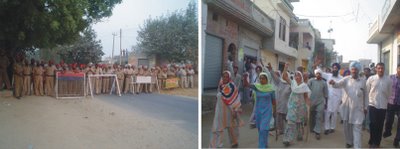
Farmers facing dispossession from their lands in different parts of Punjab are struggling to make their voices heard. They are in against formidable opponents in the powerful industrialist backed by state government. More than 300 families in Fatehgarh Chhanna and Dhaula villages of Barnala fighting to retain their farm land, now in possession of Trident Group's Abhishek Industries, were subjected to the display of this brute power again yesterday. Their land has been acquired and given away to the private company owned by Rajinder Gupta, for its expansion plans. While few of the farmers have given in to accept compensation, others are holding their ground calling the amount being offered as meager. Farmers' organizations, leading the fight-back, had called for a token protest yesterday to sow wheat in their land, now barricaded with a wall erected around it. The police got into action picking up farmers whom they could lay their hands on during the whole week. The whole area in and around these villages was turned into a police garrison. Khaki dotted every road and by-lane leading to the factory premises near the villages. The SSP, S.K. Asthana himself led the action with the police posse reinforced with heavy bandobust from neighbouring districts. Farmers led by Bhartiya Kissan Union (Ekta) activists succeeded in outmaneuvering the heavy police deployment converging in Dhaula and Chhanna. A police party managed to reach the assembly of farmers in village Dhaula but had to turn their tails faced by determined farmers, but not before taking away five people, including two teenagers.While the policemen kept watch on different barricades, farmer-activists kept trickling in, taking alternate routes through fields. By evening the group that had swelled considerably decided to move. The slogan-shouting farmers, including women, marched towards the barricade put up on the main road leading to the factory. They were greeted by heavy police party armed with batons, riot-control vehicles and water-cannons blocking the road completely. The peaceful protesters sat on one side of the road shouting slogans addressed by different farmer leaders. Having made their point with a group of media-persons covering the event, they decided to stay put.In the meanwhile, another group of farmers had assembled at village Fatehgarh Chhanna. A police contingent descended on the village with the police chief Asthana, himself leading the way. As evening set in, the farmers, who had gathered in a house approached by narrow lanes, moved to village Gurdwara announcing to call it a day. The police contingent surrounded the Gurdwara. As soon as an announcement was made from the Gurdwara speaker calling upon villagers to keep vigil, it was cut off. Villagers coming to Gurdwara were turned away from the gate by the policemen. For first time since the Gurdwara was established in the village, no evening prayers were held for the day.The farmers announced to stay the night there. The ladies of the village prepared langar. As the protesters started partaking langar in batches, the police made announcements ordering them to come out and get themselves arrested. The police plans were made obvious when an attempt was made to snatch camera of one media-person and two empty buses were driven in. He alleged his camera was broken.Village Sarpanch and members of panchayat were brought in. The SSP had a menacing tone as he asked them to go inside and tell the farmers to give in if they wanted to be saved from what he called ‘chhitar parade’ reminding them of Bhadaur (One person was killed and many were injured in a clash between the police and the residents at Bhadaur over the issue of demarcation of land of a gurdwara). He openly threatened them of throwing them all behind bars for “at least two months”.The police did not wait for the panchayat to come out. Armed with lathis and pelting brickbats they stormed into the Gurdwara. All hell broke loose as couple of the protesters tried to resist. The policemen rained lathis dragging people. The protesters, prepared for the worst, shouted they would come out voluntarily. All this while few media people present, herded together, watching meekly. No flash bulbs were popped. No one wanted to get into trouble. A single spotlight aimed towards the Gurdwara pierced the pitch darkness outside to help policemen bring the farmers onto the buses. Two buses were not enough to contain the surging farmers. More vehicles were summoned. An elderly man, who could not be identified, was brought in, held by two burly policemen in plain-clothes to the SSP. The SSP patted his back speaking something which could not be heard in the din. He was taken towards the police officers vehicles parked together. A policemen was heard shouting take him to sahib’s car. When asked who he was, the SSP feigned ignorance, cheekily adding that he might be one of his relatives if he was taken to his car. Later the SSP was heard telling someone on the phone that there was no lath charge and that no policemen went in the Gurdwara. The farmers came out on their own, he said. Inside the Gurdwara plates strewn here and there with unfinished food told a different story.The story is unfinished yet.
(see related story on http://journojp.blogspot.com/)

Monday, November 6

Re-imagining Punjab in the Globalization Age

The fast changing geopolitics of the world require us to re-imagine Punjab(s) in idioms and identities different from what seem familiar and obvious to us today, writes Surinder S. Jodhka in a symposium on 'Re-imagining Punjab' in the Seminar

Regional and linguistic identities have often been viewed as being territory bound. Quite like the old notion of nations, territory presumably provides the physical and economic grounds for the growth of a distinctive cultural consciousness, as if linguistic/regional identities are more ‘natural’ and ‘authentic’ than identities of nations or ethnics. Such identities were seen as being particularly so in the subcontinent, where national boundaries were arbitrarily drawn by the departing colonial masters.
However, such a priomordialist notion of regional and linguistic identities does not hold good in every case. Shared relationship to a territory does not automatically produce a cohesive cultural or political community. Territoriality of a given region becomes a meaningful reality only when it is claimed by some ‘community’/‘communities’. While it is possible that such communities in many instances are themselves constituted by territoriality of the region or its linguistic distinctiveness, this has not always been the case. Other social and political processes, such as religion, caste and even class could play important roles in the constitution of such identities. In other words, regions and regional identities are inherently fluid categories, constantly changing and being constructed by the relevant actors in given social, political and historical contexts.
The history of Punjab or Punjabiyat during the 20th century offers a good example of such a process. Though like many other provinces, the Indian Punjab too was reorganized as a separate state of independent India on the basis of language, it has over the years come to acquire a strong communitarian identity and is often seen as a land of the Sikhs. Despite the fact that Hindus and Muslims were in larger numbers in the region, it was the Sikhs who saw Punjab as the land of their origin and laid claim to it, successfully hegemonizing the regional/territorial identity of the Indian Punjab.1
The politics of a predominant section of the Punjabi Hindu elite, on the other hand, was geared towards de-ethnicizing and de-regionalizing themselves.2 While this certainly helped them in claiming the opportunities opened up by the new nation, it conversely helped the Sikhs in consolidating their claims over the region. Similarly, the Punjabi elite of western Punjab found Urdu as a more useful source for legitimizing their hegemony over the new nation-state of Pakistan. Muslim Punjabis, who constituted more than half the total population of pre-partition Punjab, thus rarely represented themselves through the idiom of Punjabiyat in post-colonial South Asia.
Religious communities have not been the only source of fluidity for the regional identity of Punjab. During the post-independence period, the Indian Punjab, for example, has often been imagined as a land of prosperous agriculture and, therefore, predominantly ‘rural’ in its cultural ethos and ‘ways of life’. Even though the green revolution technology was successful in several other parts of India as well, it came to be identified almost solely with Punjab. This success of agriculture also helped the locally dominant landowning caste of Jutt Sikhs to virtually emerge as the sole champions of the regional and religious identity of Punjab. The Akali politics of post-1966 Punjab was articulated not merely around the interests and aspirations of the Sikhs but also represented the agrarian interests and ethos of a dominant class of rural Punjab.3
The iconographic Sikh soldier/warrior of the colonial and post-colonial state was also quintessentially the Jutt Sikh peasant. It was this category of the mobile Punjabi peasants who, before any other community from the subcontinent, began to explore the western hemisphere.4 As is well-known to students of global migrations, the history of Indian diaspora in North America begins with Sikh settlements in America and Canada. Migrations of rural Sikhs to the countries of North America and Europe have not only continued over the years, but have almost become a cultural trait with the rural Sikhs in some pockets of Punjab. Though the Jutt Sikhs are not the only ones who have migrated out of Punjab to the West, they certainly constitute a bulk of the Sikhs living abroad.5
Apart from the long tradition of migrations and global contact, the Indian Punjab also had a vibrant urban economy. Until recently the industrial growth rate of Punjab was higher than the average for India. Punjab continues to be among the more urbanized states of India and ranked fourth in terms of the proportion of urban population among the major states of the country during the 2001 Census. Against the national average of less than 28 per cent, the urban population of Punjab in 2001 was 34 per cent.
Despite all these facts, the Indian Punjab during the post-independence period has been known primarily for its prosperous agriculture. Since the days of British rule, Punjab was viewed as a region with enormous potential for agricultural growth. The success of canal colonies in West Punjab motivated the colonial rulers to lay an extensive network of canals in the region. The Bhakra Nangal dam, one of the first major irrigation projects launched by the government of independent India, was also located in Punjab.
The success of the green revolution technology in the region did not come as a surprise to anyone. The state of Punjab soon became the land of prosperity and progress, an example par excellence of the economic achievements of India during the post-independence period, a ‘representative model’ of economic progress. The available statistics on various indicators of agricultural growth speak for themselves. Of all the states of India, Punjab’s growth rate in agriculture was the highest from the 1960s to the middle of 1980s. The annual rate of increase in production of food grains during the period 1961-62 to 1985-86 for the state was more than double the figure for the country as a whole. The percentage of high yielding varieties (HYV) of seed in the total area under food grains in Punjab was as high as 73% in 1974-5 (all India 31%) and 95% in 1983-85 (all India 54%). While Punjab had 17,459 tractors per hundred thousand holdings, the all India figure was only 714. The same holds true for most other such indicators.6 These achievements have also been widely recognized.7
At the sociological and political level, this growth of rural capitalism during the 1960s and 1970s imparted a new sense of confidence and visibility to the agrarian castes in different parts of India. Institutionalization of electoral democracy helped them dislodge the so-called upper caste elites from the regional and national political arena. In the case of Punjab, the landowning Jutts had already been the ruling elite of the region. The success of green revolution and institutionalization of democracy helped them further consolidate their position. In the emerging scenario even Sikh religious institutions came under their sway.
The triumph of agrarianism and the rise of the dominant caste farmers in the 1970s also set in motion a phase of populist politics at the regional and national levels in India. The newly emergent agrarian elite not only spoke for their own caste or class but on behalf of the entire village and the region. Their identification was not just political or interest-based and sectarian, as they saw themselves representing everyone, encompassing all conflicts and differences of caste, class or communities.
The economic supremacy that Punjab had come to acquire in independent India did not last for long. The rise of the Khalistan movement, a secessionist demand by a section of the Sikh community during the early 1980s, was a somewhat unexpected development since apart from its economic success, socially and politically too the border-state of Punjab had been a well-integrated part of India. Nor had there been any doubts about the nationalist credentials of the Sikhs. Not only had they participated in the nationalist freedom movement with considerable enthusiasm, the people of Punjab, along with those of Bengal, had suffered the most during the Partition of India in 1947. No other region of India had to pay such a price for freedom from colonial rule!
Not surprisingly, therefore, the rise of a secessionist movement in the state was for many a puzzle. Explaining the ‘Punjab crisis’ became an obsession with the academia and the popular press. A large volume of literature was generated during the early 1980s on the ‘Punjab crisis’. From political economy to modernization theory and even psychoanalysis, the academia applied virtually every available framework and perspective for understanding and explaining the ‘crisis’.
Contrary to much of the academic speculation, after some fifteen years of violence and bloodshed, Sikh militancy began to decline. This process started around the early 1990s and by the middle of the decade, the Khalistan movement was virtually over without having achieved anything in political terms. The end of the Khalistan movement, however, did not mean an end of ‘crises’ for Punjab. It was now the turn of economics and agriculture. The green revolution had already begun to lose its charm by the early 1980s. Several scholars had in fact attributed the rise of militancy directly to the crisis of Punjab agriculture. By the early 1990s, there were clear signs of economic stagnation. Unlike some other parts of India, Punjab had lost out on the opportunities opened-up by the ‘new economy’ and investments of foreign capital that had begun to come to India with the introduction of economic liberaliztion.
The discourse of crisis found more ammunition during the post-reforms period when Punjab and some other parts of India saw a sudden spurt in the incidence of suicides by cultivating farmers. By the turn of the century, agriculture in Punjab had lost nearly all its sheen, the emblematic Punjabi farmer seen nowhere in the new imageries of a globalizing India. The younger generation of those who once proudly identified with agriculture and rural ethos no longer seemed inspired by village life and the economic opportunities it offered.
Underlying the ‘crises’ generated by a decline of agriculture and disenchantment with the village were the changing ground realities. The changes that came about in the countryside with the success of the green revolution also produced a new class of rural rich who had experienced economic mobility through their active involvement with the larger capitalist market. The new technology gave them tractors, took them to the mandi towns and integrated them with the market for buying not only fertilizers and pesticides but also white goods and an urban lifestyle. Their changing aspirations could not be satisfied simply by being in the village. They began to send their children to urban schools and colleges for better education. Some of them also invested the surpluses they generated from agriculture into urban trade and other avenues of investments in the non-agricultural economy. Even those who did not have large size holdings tried to move out of the village. Most agricultural households in Punjab today have become or are trying to become pluri-active, ‘standing between farming and other activities whether as seasonal labourers or small-scale entrepreneurs in the local economy… Agriculture and farming is no more an all-encompassing way of life and identity.’8
The available official data on employment patterns in Punjab has begun to reflect this quite clearly. For example, the proportion of cultivators in the total number of main workers in Punjab declined from 46.56 in 1971 to 31.44 in 1991, and further to 22.60 by 2001. While the share of cultivators has been consistently falling, that of the agricultural labourers had been rising until the 1991 Census. However, over the last decade, viz. from 1991 to 2001, even their proportion declined significantly, from 23.82 to 16.30. In other words, though two-third of Punjab’s population still lives in rural areas, only around 39% of the main workers in the state are directly employed in agriculture. The comparable figure for the country as a whole is still above 58%.
Who is trying to move out of agriculture? The trend of moving out of agriculture is perhaps not confined to any specific class or category. While marginal and small cultivators seem to be moving out of agriculture, the bigger farmer is moving out of the village itself. The big farmers of Punjab invariably have a part of their family living in the town. Their children go to urban schools/colleges, and they invest their surplus in non-agricultural activities.
Not only has there been a fragmentation of farming classes, the rural social structure has also undergone a near complete transformation over the last three or four decades. My recent study of changing caste relations in rural Punjab clearly reflects this process. As I have argued elsewhere,9 commercialization and mechanization of agriculture on the one hand and introduction of democratic political process on the other have together fundamentally transformed caste relations in rural Punjab. Over the last twenty years or so a large proportion of dalits in Punjab have consciously dissociated themselves from their traditional occupations as also distanced from everyday engagement with the agrarian economy, which earlier provided the source of power for the locally dominant castes over them. They have also been investing in building their own cultural resources in the village, in gurudwaras and dharamshalas.
The growing autonomy of the dalits from the ‘traditional’ rural economy and structures of patronage and loyalty has created a rather piquant situation in the countryside with potentially far-reaching political implications. While the institutions supporting the ideas and structures of hierarchy have nearly disintegrated, the upper castes have not yet shed their prejudice against the former ‘untouchable’ groups. Nor have they reconciled to the changed ground realities. In the emerging scenario, local dalits have begun to assert for equal rights and a share from the resources that belong commonly to the village and had so far been in the exclusive control of the locally dominant caste groups or individual households.
Seen purely through economic data, Indian Punjab continues to be an agriculturally developed region of the country, producing much more than what it requires for its own consumption. Even though occupying merely 1.53% of the total land area of India, Punjab farmers produce nearly 13% of the total food grains (22.6% of wheat and 10.8% of rice) of the country. Interestingly, in terms of objective indicators, Punjab has been a ‘progressive’ state otherwise also. For example, in terms of the Human Development Index, Punjab is second only to Kerala. The available official data also points towards a revival of its economy. The growth rates of Punjab – agriculture or industry – are no longer negative. Notwithstanding the frequent reports of corruption and scandals, the urban centres of Punjab seem to be picking-up in terms of growth of infrastructure and real-estate.
However, the Indian Punjab today needs to be re-imagined in more than economic terms alone. The canvas of its change is much larger and broader. The fragmentation of village and its social structure, the growing differentiation among the agrarian classes, its rapid urbanization, will all have far reaching implications for the local power structure. Given that Punjab has a large proportion of Scheduled Caste population, the newly acquired agency among the dalits can also have serious implications for regional politics.10 The earlier hegemony of the rural Jutt culture is fast disintegrating from within and outside. This would also change the manner in which the dominant elite articulate the regional identity and their perceptions of the larger interests of Punjab.
As mentioned above, some pockets of Punjab have had a long history of out-migration, mostly to the developed countries of the western hemisphere. Over the years Punjabi/Sikh diaspora has gained in confidence and economic resources with a strong sense of identity and desire to participate in the development of the region and communities of their origin. They have also been investing in consolidation of their cultural resources that would give them respectability in the countries where they live as citizens, viz. mobilizing funds to set-up chairs in some of the most prestigious universities of the western world. They have been participating in the political process, getting elected to local and national political bodies which enable them in negotiating with the cultures and polities of their host societies.
The fast changing geopolitics of the world during the opening decade of the 21st century has important implications for the Punjabs and their futures. Though the hostile visa regimes of India and Pakistan continue to be an obstacle, traffic of common citizens across the Indo-Pak border has been steadily increasing. The larger politics of the two countries notwithstanding, this loosening of border has produced a sense of excitement and opened a window of hope for all shades and sections of Punjabis .
What implications would these new processes have for the manner in which we have imagined Punjab and Punjabiyat – within the national and global contexts? Will the processes of globalization and the new technologies enable the two Punjabs to rediscover their common cultural heritage? How would a loosening of the border and opening of trade routes influence the economies of the two Punjabs? Would the decline of agriculture and rapid urbanization of the state develop a new middle class imagery of the state? Though it is not easy to answer these questions, some of these processes are sure to bring positive and enriching outcomes. They will also require us to re-imagine Punjab(s) in idioms and identities different from what seem familiar and obvious to us today.
(Surinder S. Jodhka is Professor of Sociology, Centre for the Study of Social Systems, Jawaharlal Nehru University, Delhi)

Tuesday, October 24

Why are Farmers Committing Suicide?

The marginal and small farmers are being passively sacrificed in the name of progress in India, concludes Tom Deiters who blames the occurrences of farmers’ suicides on the globalisation project while noting that the immediate causes are multiple.

Why are farmers committing suicide? To answer this question I shall try to connect the dots by connecting Chotian (in the southern Punjab district of Sangrur which has the highest rates of farmer suicides in the region and therefore the answer to the causes of these farmer suicides could partially be found in this village) with India and world. Through the case study of Chotian I have demonstrated that the farmer suicides have multiple causes. The suicides in Punjab are the result of mental stress and this mental stress is most often caused by poverty and especially by indebtedness.
Indebtedness and the inability to earn enough income to relief the debt will assault the farmers feeling of self-esteem and respect. In many cases the individuals who committed suicide where responsible for the income and this debt created the feeling that they were incapable of taking care of their loved ones and themselves. This feeling has brought shame upon them and might even have confirmed for them the idea of being backward or underdeveloped. Once this has entered their minds it accumulates and creates a heavy mental burden. It is important to note that it is most likely that most farmers who committed suicide probably blamed themselves for their poverty and indebtedness.
Here I would like to redirect this personal blame of these farmers towards the development. project and globalisation. project that had been introduced as part to modernise these backward. farmers. The introduction of the Green Revolution and the introduction of the new High Yielding Variety Seeds (HYVs) coupled with capital intensive modern implements have increased the burden of debt immensely. Although the Green Revolution. had brought the major achievement of food self sufficiency, this agricultural development strategy came at severe costs, as we have concluded in our case study of Punjab.
The introduction of these new High Yielding Varieties (HYVs) of seeds led to loss of crop variety and the diversity of the indigenous agriculture system was replaced by a narrow genetic based on monoculture The Green Revolution focused mainly on international traded grains, which meant strategically eliminating mixed and rotational cropping. This technology dominated type of farming was supposed to bring the sluggish backward Indian farmer into the modern world. The use of chemicals was promoted and it has led to intensification of land use which in its turn has led to the destabilisation of the natural balance, social balance and the balance within the farmers themselves. The disturbance of the natural balance has resulted in an increase in pest, water logging, salinity, shortage of water, poisoning of the waterways, logging of trees and it has reduced soil fertility, biodiversity and animal life. The disturbance in the social balance in society has led to breaking up of traditional values and individualization of families. The newly introduced farming system has increased costs of production which in turn has led to the indebtedness and the disturbance of the harmony within farmers themselves. We can draw a lesson from these suicides as these acts are showing us that the agricultural system that had been introduced as part of a .development. project has failed for especially the weaker parts of Indian society i.e. agricultural labourers, marginal and small farmers.
From 1997 onwards the occurrences of farmer suicides where rising rapidly throughout India. This sudden mushrooming of the occurrences of farmers suicides are related to the globalisation project.. More and more farmers were becoming indebted part because of the withdrawal of institutional credit from the rural areas as a result of the deregulation and the privatisation of the banking sector. This decision has limited especially the marginal and small farmers in their credit sources and they have become virtually
completely reliant upon the informal sector for their credit needs. Globalisation has also diminished subsidies and price support given to farmers which has affected their income negatively. The prices that farmers would receive for their crops on the open market are often less then the cost of production, bringing structural loss. As a result of the withdrawal from the government in food purchasing prices in the open market did not reflect the local situation of availability but reflected international prices which are artificial. An example of this is the high price of cotton on the international market which caused for many farmers in Punjab and other areas to switch to cotton. What these farmers did not realise is that international prices for agricultural commodities are highly volatile and they tend to fluctuate.
Thus when the prices fell and some harvests also failed because of various pest and untimely rains these farmers were in deep distress and many of them committed suicide. At the heart of the agricultural crisis and the farmers suicides are the raising costs of production. The costs of seeds, pesticides, fertilisers and machinery are too much to bear for marginal and small farmers still these farmers will purchase these inputs because they do not wish to be .backward.. The companies who sell these agricultural products together with the moneylenders are the ones who are benefiting from this agricultural system. These agricultural companies are in large part multinationals who are gaining more and more foothold in the Indian rural areas as a result of the liberalisation of agriculture in concordance with the Agreement on Agriculture. These companies are given subsidies by the Indian government to build the infrastructure that will enable them to make huge profits and tap into the huge Indian and Asian market. Eventually the wealth accrued in agriculture will be concentrated into the hands of few international agricultural corporations. Liberalization and the commercialization of agriculture has already been the death of many farmers throughout Punjab, India and the world and by further opening up agricultural markets, the Government is signing the death sentence for its marginal and small farmers.
The government is clearly aiming towards an export orientated agricultural system
which will imply that farmers will be forced to diversify towards .high-value. products for export. The fallacy of the export orientated diversification model of agriculture is that the reason and intention why the Government wants this type of diversification is because of the potential export earnings. The foundation of the new path for agriculture is therefore based on macro-economic reasoning, just like the reasoning for the .green revolution., which does not seem to take into account the micro-economic, social, cultural and environmental implications. This type of diversification is not taking into account the real needs and interests of the primary producers. The Government of India is again making the same mistake it made in the .Green Revolution., whereby they are forcing a top down technocratic-economic solution on farmers. During the Green Revolution the aim was raising production for self-sufficiency and the current neo-liberal agricultural policy introduced in the 1990.s has the objective of raising production for exports earnings. The parallel between the .Green Revolution. and the current diversification for export policy becomes even more apparent if we are to consider that both of these policies were steered and imported from outside of India, and therefore were completely disassociated with the agricultural strengths and reality of India.
The Indian government is slowly committing Indian farmers with an on average operational landholding of one hectare, with farmers of the Western world with holdings exceeding 1000 hectares from most parts (Arlagh, 2003). This huge discrepancy in opportunity and power between Indian and Western farmers gives us to question the sanity of Indian policymakers. The government solutions to the agricultural crisis are flawed because they are only thinking of changing the structure of the agricultural system a little without ever coming to the core of the crisis and thereby this crisis for marginal and small farmers will be perpetuated. The government just as it did in the .Green Revolution. is again looking for .technological fixes. to raise production and for top down solutions that have been created outside their own borders and outside the local context of the agricultural diversity of India .
Thereby the approach of the government to the agricultural crisis in India is not based on
solving the agricultural crisis and aiding the marginal and small farmers, in essence they are denying their existence and the government is merely planning to phase out these farmers in the name of economic .progress. and growth. It seems that the government has not learnt from the failures of the .Green Revolution. and is prepared to make the same mistakes again.
In India the marginal and small farmers are being passively sacrificed in the name of progress. and policymakers with their lack of creativity and their narrow economic thinking are unable or maybe unwilling to resolve this major crisis although it is happening right underneath their eyes. There need not be a one track solution to the agrarian crisis and steps should be taken that fit the profile of the diverse needs of small and large farmers. Modern farming and focus on marketing might bring prosperity to a few farmers but it is not the solution for all farmers. The first and utmost important step to take at this stage of the crisis is to reduce the costs of production of farmers and a good method of doing this is to have farmers switch to organic farming which can if properly guided, bring down the costs to zero furthermore in the Western world there is fast growing market for organic produce and fair trade agriculture.
In any case if the negative atmosphere and the agriculture crisis are to be relieved, it will be important to look at those people who might be capable of bringing the positive change. Those people who are able to move beyond personal motifs and are truly involved and moved by the human tragedy that is occurring on a day to day basis. This would mean that we need to look beyond government, as they seem incapable and to entrenched to create such a positive move. The change must come from inspired individuals and organisations that work from the grassroots and in participation with the villagers to find solutions for the problems. Such a change should break through clogging traditions and include all villagers young and old, women and men. Only if there is a situation of openness can positive change grows.
(Conclusion of the final thesis ‘Signing the death sentence of Indian farmers - The implications of development strategies and neoliberal globalisation for small and marginal farmers in India’ submitted to University of Amsterdam)