
The pro-Khalistan ideologues abroad are oblivious of the groundswell in their native land of Punjab. But the best way to mute their voices democratically would be to expose them to the situation in the state. Besides, the numerous issues which continue to kindle fires among them need to be addressed, writes Kanwar Sandhu in Hindustan Times
ON BAISAKHI, while has been business as usual in Punjab, it has not been so in North America. In rural Punjab, people have been busy in harvesting operations and their urban brethren in the grip of IPL cricket fever on their television screens. In the border belt of Amritsar, the release of Sarabjit Singh, who is on death row in Pakistan, and the Amritsar (South) bypoll are on top of people's agenda. At the political conferences in Damdama Sahib on occasion of Baisakhi, while the mainline political parties took potshots at each other, proKhalistan elements struggled to attract bare notice. But in the North American cities of Vancouver, Toronto and New York, Baisakhi was an occasion for pro-Khalistan elements to vie for center stage. At the 21st Sikh Day Parade in New York City, several resolutions in favour of Khalistan were passed, besides sloganeering. In Toronto, although the organisers of the Baisakhi Dal parade did not allow the proKhalistan elements to enter a float depicting the horrendous events of 1984 and after, the latter managed to carry a huge "proKhalistan" banner at the head of the parade, which was attended by nearly 50,000 people.
Why the vast difference in attitude? On the soil of Punjab, people have moved on from the era of militancy Abroad, particu . larly in North America, Khalistan continues to whip up passions. This has been so for years, but why? Last year, during the Baisakhi parade in Surrey near Vancouver, Khalistan slogans were raised and the radical ideologues were eulogised. The disparate pulls and pressures have sharply polarised the Punjabi community, including Sikhs in these countries, besides impacting local politics. Since terrorism became a part and parcel of the Khalistan movement in Punjab, raising the separatist bogey could isolate the Sikh community further in North America, where terrorism in any form is abhorred. Politically, like other immigrants, most Sikhs support the Liberal party, which is currently in the Opposition in Canada. While the ruling Conservative Party leaders have been shying away from attending the Baisakhi Day parade, some Opposition MPs did attend it this time. But, in case the polarisation persists, even the Liberal party leaders may stay away from it and the controversies surrounding it.
At home, the unfortunate result is that Punjab, once the land of five rivers, faces yet another chasm of sorts - an ideological one this time. First fractured by Partition and then truncated by the Punjabi Suba agitation, it now finds a sizeable part of its diaspora pulling in a different direc tion. This leaves the land a fertile ground for seeds of discontent to flourish. Unless the two disparate streams in the native and adopted lands are reconciled, the numerous challenges remain un-addressed. Since Khalistan as an issue remains afloat abroad, it is important to introspect on the past in order to move forward. What caused the holocaust of 1984 and after? Was the Congress leadership at the Centre and in the state solely to blame? Did the Shiromani Akali Dal leadership of the time rise to the occasion to stem the rot or did it too take the bait? What role did the community leaders, the media and others play as the situation slumped from one abysmal depth to another? Whether one agrees or not, the fact is that the Khalistan movement did not lead anywhere and only caused unending misery because its foundations were hollow. It was nothing more than an emotive bubble that burst in no time. The community was pushed headlong into it without its basis, ramifications or its contours having been deliberated. Those who continue to hold the banner of separatism need to ask themselves one simple question: are things any different now?
Besides introspection, the political leadership in Punjab should put their weight behind the Union Government to allow the pro-Khalistan elements abroad to visit their native land to see things for themselves. When they realise that the raison d'etre of the war they are waging has already been neutralised at home, they would see the futility of their "struggle" abroad. Of course, some part of the phenomenon abroad is psychological, which is common to many immigrant groups. The Irish Republican Army found ardent supporters in the USA and some of these supporters were descendents of Irish immigrants who had come to the USA in the early 1900s! So is it for many others, who become fastidious when it comes to "things back home". The driving force among them seems to be a reaction against a society where everybody is equal but nobody is important. Besides, the freedom of expression allows them to push even their outlandish agendas, provided they do it within democratic norms. Yet there are lots of people among them who would be realistic enough to see reason.
There is no doubt that one of the issues which continues to kindle the fires at home and abroad is the failure of successive government at the Centre to take those guilty of the Sikh carnage in Delhi and elsewhere to justice. The second issue that continues to rankle is the excesses by the security forces during the violent phase in Punjab. Unfortunately, neither the Congress government of Captain Amarinder Singh nor the SAD-BJP government of Parkash Singh Badal thought it fit to address the issue, which resurfaces every now and then. Besides providing an agenda to the radical elements at home, these issues render most visiting Sikh leaders abroad speechless forcing them to speak their language amidst them.
Pragmatism took the better of the community at home many years ago. It is time the government facilitates the elements abroad also to take a realistic view so that the collective strength is put to use to push not just the developmental agenda but also the wider issues. With the Union Government having set up a fresh Commission to review Centre-State relations, there is a chance once again to push for greater autonomy for states, especially in the light of increasing globalisation. Badal should solicit all-round support, including of the diaspora abroad, to put up a forceful case before the Commission.
Saturday, May 3


Tuesday, January 15
Friends don't die
This is one part of the bloody tale of Khalistan movement that has remained untold. Rahul Pandita recounts, in his blog Sanity Sucks, the armed resistance put up by handful of leftist cadres to terrorists who had become a law unto themselves in Punjab until they were contained at a heavy cost to human lives across the divide
 “He was carrying his revolver when they shot him dead.” The old caretaker at the Ghadar Memorial Hall in Jalandhar takes out a blue handkerchief and spreads its content on the table. There is an old spectacles frame and a blood-stained bus ticket, recovered from Darshan Canadian’s shirt pocket.
 “He was carrying his revolver when they shot him dead.” The old caretaker at the Ghadar Memorial Hall in Jalandhar takes out a blue handkerchief and spreads its content on the table. There is an old spectacles frame and a blood-stained bus ticket, recovered from Darshan Canadian’s shirt pocket.
“The problem with Comrades is that they are very fond of justifying their viewpoint. When the two young men waylaid him, he got into an argument with them instead of taking out his revolver,” an old associate of Canadian tells us. It was on September 25, 1986 when Darshan Canadian was shot dead by Khalistani terrorists.
In Punjab, the wounds have healed more or less. One deadly decade of terrorism has passed since long. Beyond Punjab, people only know of a super cop and a chief minister who finally led the Khalistani dream to its nemesis. But in Punjab, those who actually offered resistance to the movement without being protected by gun-toting policemen, are part of the folklore, much like Bhagat Singh. These are a handful of Comrades, like Darshan Canadian, who laid down their lives fighting religious fundamentalism. These were the men who were armed only with idealism.
 In village Talwandi Salem, the mango tree still exists. Sukhwinder Singh Sandhu takes me there. At first, he talks in a matter-of-fact manner. And then his eyes turn wet. Sandhu vividly remembers that sunny morning on March 23, 1988, when he left his cousin Avtaar Singh ‘Paash’ and his friend Hansraj near the mango tree at the family tubewell. “When we heard the gunshots, Paash’s mother thought that the nearby cold storage was on fire. But I knew “saade ghar te aag lagi hai (it’s our house which has been set afire.)”
The most dangerous thing is to be filled with stillness/Not to feel any agony and bear it all/Leaving home for work and from work return home/The most dangerous thing is the death of our dreams… These lines by Paash, considered by many as Punjab’s most influential revolutionary poet is, in a way, a reflection of his combativeness. In the mid-`80s Paash was the cheerleader of resistance against Punjab terrorism.
Through his writings, he had become a festering wound for fundamentalism. From America, where he had shifted in 1985, he took out Anti-47, a magazine that opposed those who supported Khalistan. “In his village, his friends had advised him to go underground since he was on the hitlist of terrorists,” remembers Sukhwinder. But he had refused. It was on that morning in 1988 when acting upon a tip-off, terrorists lay their hands upon Paash and his friend. After being hit by a bullet on his hand, Paash tried to ecsape but fell down near the mango tree. The terrorists pumped an entire burst into his head. Hansraj was also killed nearby. Paash was 38. Fifty-seven years ago, on the same day, Bhagat Singh had achieved
martyrdom.
 Not very far from where his brother fell to bullets, Harbans Lal sits in his newly-built bigger home, trying to remember his brother’s journey. “Hansraj was very close to Paash and even in their death they were together,” he says. After Hansraj’s death, the village elders advised him to sell off his land and settle down somewhere else. “But that would have been an insult to Hansraj’s martyrdom,” says Harbans Lal. After his son’s death, their father stopped working in the family fields. In the memory of his late brother, Harbans Lal encouraged his son to become a weightlifter. (“I wanted him to be as physically strong as Hansraj was mentally”).
martyrdom.
Not very far from where his brother fell to bullets, Harbans Lal sits in his newly-built bigger home, trying to remember his brother’s journey. “Hansraj was very close to Paash and even in their death they were together,” he says. After Hansraj’s death, the village elders advised him to sell off his land and settle down somewhere else. “But that would have been an insult to Hansraj’s martyrdom,” says Harbans Lal. After his son’s death, their father stopped working in the family fields. In the memory of his late brother, Harbans Lal encouraged his son to become a weightlifter. (“I wanted him to be as physically strong as Hansraj was mentally”).
In retaliation to these killings, their comrades killed a woman and her father in Talwindi Salem. The woman, a supporter of Khalistan, is believed to have passed on information about Paash’s location to his killers.
In Majha area – the worst-affected area during militancy – Harsha Sheena village is the Panjshir of Punjab. Long before Ahmad Shah Massoud was assassinated by two men posing as journalists two days before 9/11, a woman met Hardev Babbu just outside his home.
 Babbu and his other comrades had been paying the terrorists back in the same coin – hitting them without waiting for them to attack. In many areas, the fundamentalists would block entry points leading to Hindu households, denying them access to essential commodities like milk and vegetables. But Babbu, a Sikh by birth, would lead his men to break such blockades. It was after a dreaded terrorist, Kuldeep Singh Tolanangal was killed by Babbu’s bullet, that the terrorists decided to annihilate him. But they could not fight back. So they hatched a plan. Posing as a journalist, the woman met Babbu and enticed him to come to Amritsar for an interview. It was there that Babbu was drugged and after being tortured brutally, his head was cut off and hung outside the gurudwara in his village to terrorise his friends. But instead of discouraging people from speaking out against terrorists, such killings motivated men like Tarsem Peter. Four years before Babbu’s barbaric killing, Comrade Baldev Mann was killed by terrorists in Harsha Sheena. “That day, I became a full-time opponent of oppression,” says Peter.
 One night, while returning after addressing a public gathering, Peter was stopped by CRPF men. “I told them clearly that I had hidden a revolver under my motorcycle’s seat and that it was meant for self-defence. They let me go,” recalls Peter. Today Peter is the state president of a labour union.
In Lakhan ka Padda village, poet Jaimal Padda was shot dead on March 17, 1988. During the peak of terrorism, Padda would take out processions against Khalistan movement and write against terrorists in his journal. For his departed comrades, he had written a poem: Mitran di yaad nayo bhulni (The memory of friends won’t fade away). Long after he is gone, Padda is still remembered by his friends. It is not important to raise statues in memory. Carrying forward his work is how he is being kept alive.
Years after the Khalistan movement withered away, dirty politics has begun once again. Sikh fundamentalist Jarnail Singh Bhindranwale’s portrait has been installed at the SGPC museum in Amritsar. How do those who opposed the idea of Khalistan tooth and nail see it? “The whole politics of Punjab is based on such bogus issues; they are trying to divert peoples’ attention from problems like unemployment, etc.,” says writer Balbir Parwana. “Everything has been commodified,” says Peter. “Recently I saw 10-12 girls in a village bus. All of them wore air-hostess uniforms and wanted to make it big. But the problem is that the so-called university they go to operates from a single room,” he adds. “Some of us frequent a food-stall that sells fish fry. But this evening we couldn’t have it. A prominent politician from Punjab is staying at Radisson Hotel here and he has ordered the entire stock of fish for his chamchas and himself,” another Comrade tells us in Jalandhar.
As the night approaches, I am led to an ahaata (open-air bar) for a few rounds of vodka by some of the Comrades. After three rounds, one Comrade slurringly tells us: “You know, Yudhishtir’s (the eldest of Pandava brothers) chariot used to run two inches above ground since he only used to speak the truth. But after his role in Ashwathama’s death, his chariot hit the ground. If you really ask me, the chariots of today’s politicians have got stuck in the ground since they lie so much.”
Next morning, in Harsha Sheena, Hardev Babbu’s closest friend, Surjit Sheena is sitting outside the CPI-ML office. From the walls, the departed comrades stare back. “There have been some cases recently where postgraduate boys were involved in chain-snatching since there are no jobs,” he rues. I remain silent. After a pause, I ask him, “Do you still remember Comrade Babbu?” He looks at me, and then at Babbu’s picture. There is another pause and then he speaks: “Friends don’t die.”
Tuesday, September 25
Chemical generation
Punjabis are poisoning themselves, according to a report in The Economist
If Indian newspaper reports are to be believed, the children of Punjab are in the throes of a grey
revolution. Even those as young as ten are sprouting tufts of white and grey hair. Some are going blind. In Punjabi villages, children and adults are afflicted by uncommon cancers.
The reason is massive and unregulated use of pesticides and other agricultural chemicals in India’s most intensively farmed state. According to an environmental report by Punjab’s government, the modest-sized state accounts for 17% of India’s total pesticide use. The state’s water, people, animals, milk and agricultural produce are all poisoned with the stuff.
Ignorance is part of the problem. The report includes details of a survey suggesting that nearly one-third of Punjabi farmers were unaware that pesticides come with instructions for use. Half of the farmers ignored these instructions. Three-quarters put empty pesticide containers to domestic uses.
Yet, over 250 dense pages, the report also reveals structural problems in the state’s agricultural sector that no mere education programme could address.
Punjab was the totemic success of India’s green revolution, a leap forward in agricultural productivity during the 1960s and 1970s that ended the subcontinent’s periodic famines. It was based on the introduction of a few simple technologies—including artificial fertilisers, pesticides and better seeds. In Punjab, especially, the benefits were massive.
Between 1960 and 2005 the state’s annual food-grain production increased from 3m tonnes to 25m tonnes. Punjab, one of India’s richest states on a per capita basis, supplies more than half the country’s central grain reserves.
But the successes of the green revolution are in retreat. Punjab’s agricultural growth rate has slowed from 5% in the 1980s to less than 2% since 2000. In the past five years production of food grains has increased by 2%, and the state's population has grown by 8.6%.
“Punjab, the most stunning example of the green revolution in India, is now at the crossroads,” the report states. “The present agricultural system in Punjab has become unsustainable and non-profitable... the state’s agriculture has reached the highest production levels possible under the available technologies.”
Indeed, the technologies available to farmers are part of the problem: “Over-intensification of agriculture over the years has led to overall degradation of the fragile agro-ecosystem of the state”
In particular, massive use of nitrogenous fertilisers—which draw multiple crops from Punjab’s rather poor soil—has reduced the soil’s overall fertility and led to widespread soil erosion.
Massive application of pesticides has meanwhile extinguished some pests and insects while letting others thrive, including the American bollworm, an unpleasant cotton blight, and rice-leaf folder. Many of these survivors have developed resistance to common pesticides.
Intensive irrigation—especially from tube-wells, of which there are over a million in Punjab—has depleted the water-table. It dropped by 55cm each year between 1993 and 2003. Partly as a result, the land irrigated by canals has decreased by 35% since 1990.
Use of sewage and industrially contaminated water for irrigation has drenched Punjab’s soils in heavy metals and other poisons.
The state’s government is not entirely passive before this catastrophe. It has banned the use of several agricultural chemicals. And it has taken steps to encourage organic farming. But there is much more it could do.
In particular, it needs to scrap its populist policy—reintroduced in 2005—of providing farmers with free electricity. Though a great vote-grabber, the policy encourages farmers to pump water up from their tube-wells both day and night.
Equally disastrous is a subsidy on agricultural fertilisers, for which India’s central government is responsible. There is little hope of turning Indian farmers greener until both subsidies are ended.
Meanwhile, the report by Punjab’s government encourages farmers to alleviate the twin crises of environmental degradation and falling productivity by returning to traditional practices.
It recommends they use rice and wheat straw for mulch instead of burning it, rotate their crops, use a range of different seeds, manure their fields, and so on. In short, it recommends many of the agricultural practices that the green revolution swept away.
Friday, September 7
Partition
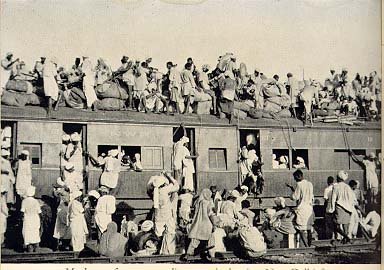
"Moslem refugees crowding a train that will take them from Delhi into Pakistan" read the caption of the photograph published in The Manchester Guardian on August 27, 1947
Punjab holocaust of 1947
Ishtiaq Ahmed revisits partition to note that the gangs from Hindu, Sikh and Muslim communities excelled each other in inflicting cruelty on hapless men, women and children
Intelligence about private armies and sale and movement of arms and ammunition had been collected by the Punjab administration since a long time, and the fact that a very large population in Punjab had served in the army should have left no doubt that a bloodbath would occur if proper arrangements were not made to prevent it. The Sikhs could always use their kirpans as daggers. They were also better organised for the final showdown. Governor Jenkins requested at least four divisions of troops under British command to supervise the partition, but the British government replied curtly that no such divisions existed. Mountbatten remained supremely confident that Jinnah, Nehru, Patel, Tara Singh, Giani Kartar Singh and others would exercise their influence in seeing to it that the partition of Punjab could be carried out peacefully without causing any displacement of people!My extensive interviews with Muslim survivors from East Punjab show that almost nobody in the rural areas had any idea that Punjab will be partitioned; much less that they will have to abandon hearth and home. Hindus and Sikhs in the villages and small towns of western Punjab were equally unaware of what lay in store for them, although half a million had moved eastwards beginning from March 1947. Conspiracy theories have surrounded the Radcliffe Award of August 17, but a serious analysis would reveal that it largely followed the "contiguous population" principle and "other factors" were only recognised partially. Thus despite Sikh and Hindu arguments about owning 75 per cent or more property in Lahore and other districts of Lahore division they were given to Pakistan including Nankana Sahib, the birthplace of Guru Nanak; so were the canal colonies of Lyallpur and Montgomery where the Sikhs owned nearly 75 per cent of rich agricultural land. In any event, the Sikh holy city of Amritsar remained in India because Amritsar district had a non-Muslim majority. But three tehsils of the Gurdaspur district on the eastern bank of the Ravi -- Gurdaspur, Batala and Pathankot (non-Muslim majority) -- were given to India, although the district as a whole had a very narrow Muslim majority of 51.1 per cent. Thus the non-Muslim majority Ferozepur district in the southwest and Gurdaspur district (minus Shakargarh which was on the western bank of the Ravi and given to Pakistan) in the northeast and the Wagah-Attari region in the middle were connected to form an international border more or less equidistant between Lahore and Amritsar. From Lahore the border followed the Ravi upwards into Kashmir. For serious scholars of the Radcliffe Award it would be interesting to note that it corresponded exactly to the Breakdown Plan which Viceroy Wavell had sent as a top secret document to London on February 7, 1946. Wavell believed that the British should pull out quickly in case of an uprising. He had proposed a border in a partitioned Punjab, which was identical to the Radcliffe Award.From August 18 onwards hell literally broke loose, especially in East Punjab where troops from the Sikh states such as Patiala, Nabha and Faridkot were involved in the attacks. The successor governments of East and West Punjab proved thoroughly incompetent in protecting the lives of the minorities. There is abundant evidence that the administrations turned partisan on both sides. Suddenly the greatest involuntary migration in history began to take place. The Punjab Boundary Force was disbanded on September 1 as it proved to be completely ineffective and in some cases partisan. The Indian and Pakistani military then agreed to form mixed units to supervise transfer of populations. This formula worked much better and hundreds of thousands of lives could be saved, but even their best efforts proved to be grossly inadequate.From East Punjab some six million Muslims tried to cross the border into Pakistan while some four million Hindus and Sikhs moved in the opposite direction from West Punjab. According to Sir Penderel Moon 60,000 Hindus and Sikhs were killed in West Punjab and twice as many: 120,000 Muslims in East Punjab. This estimate is too low. Justice G D Kholsa claimed that at least 500,000 died, of which 200,000 to 250,000 were Hindus and Sikhs. He admitted that more Muslims were killed in East Punjab than Hindus and Sikhs in West Punjab. Lt-General (r) Aftab Ahmad Khan who served in the Punjab Boundary Force and then in the Pakistani force that along with Indian units escorted refugee conveys across the border, claimed in a letter to me that at least 500,000 Muslims lost their lives. I have done interviews on both sides of Punjab. There is no doubt that many more Muslims lost their lives. Between 700,000 and 800,000 Hindus, Muslims and Sikhs perished altogether. That year the monsoons were also in a bloody mood. A large number of deaths was the result of cholera, dysentery, malaria and typhoid which plagued the refugee camps and the caravans on the move. Good people from all communities helped their neighbours and friends and even complete strangers. The Khaksars did a great job in protecting Hindus and Sikhs in Rawalpindi while in Amritsar the communists will never be forgotten for saving thousands of lives. The Sikh hordes did not touch Muslims who crossed into Malerkotla State, but those just a few feet away from its borders were cut down without any mercy. Thanks to Guru Gobind Singh's instructions, the Muslims of Malerkotla were not to be harmed come what may in the future because the Nawab had not complied with the demands of the Mughals to arrest the Guru's minor sons who were passing through his State. Malerkotla is the only Muslim-majority town in East Punjab and elects one member of the East Punjab Assembly. The killing units on both sides were formed by nexuses of local political bosses, police, corrupt magistrates, badmashes (criminals), fanatical religious figures and drug addicts from all the communities. The gangs excelled each other in inflicting cruelty on hapless men, women and children. Revenge, "communal honour", loot and lust were the main factors that impelled them to commit crimes against humanity. There was nothing remotely noble about their conduct. In this regard the shameful role of communal newspaper needs to be particularly condemned. They played a most vicious role in creating the mindset that demonised and dehumanised rival communities. As far as the main leadership is concerned, we should note that a Gandhi-Jinnah peace appeal was issued as early as mid April 1947, but it did little to change the situation on the ground. Jawaharlal Nehru intervened personally to save the lives of thousands of Muslims in Batala and Jalandhar while the goondas of Sardar Patel funded bomb factories in Amritsar and elsewhere. Prime Minister Nehru and Prime Minister Liaqat Ali Khan together toured the two Punjabs in the last days of August trying to calm down the situation, but things had gone out of control. Although Delhi was not administratively a part of Punjab its Muslims had to bear the fallout of the Punjab bloodbath. The late Dr Ishtiaq Hussain Qureshi has written what happened to thousands of desperate Muslims who pleaded to Gandhiji to save them. He promised to do his best. Dr Qureshi notes that most of them survived and concludes that Gandhiji kept his word.
The writer is professor of political science at the University of Stockholm, Sweden. Email: Ishtiaq.Ahmed@statsvet.su.se
Subscribe to:
Posts (Atom)

